 German
 French
 Spanish
 Portuguese
 Russian
 Japan
Japan Italian
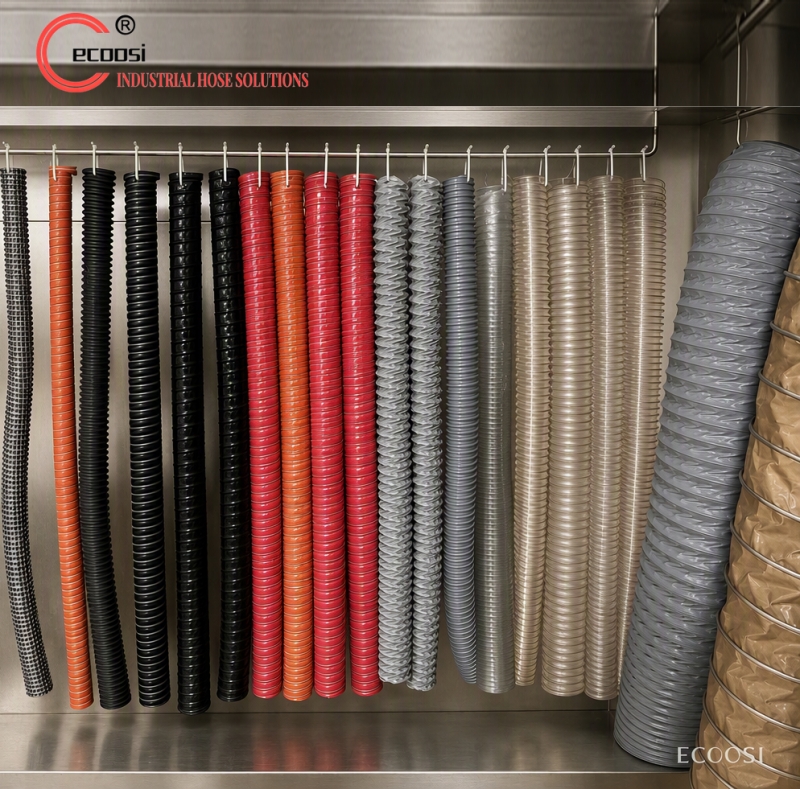
PVC vs PU vs Silicone Ducting: How to Choose the Right Flexible Hose for Your Application
PVC vs PU vs Silicone Ducting: How to Choose the Right Flexible Hose for Your Application
A practical guide for industrial buyers, facility managers, and OEM engineers — from someone who actually manufactures all three.
You've been handed a spec sheet. Or a budget. Or both. And now you need to pick a flexible duct hose that won't fail on the job — without overpaying for features you don't need.
You've probably narrowed it down to three materials: PVC, polyurethane (PU), or silicone. Each one has its loyalists. Each one shows up across every major manufacturer's catalog. But they are not interchangeable — and picking the wrong one means downtime, replacement costs, or worse: a safety incident.
Here's the framework we use with our own OEM and distribution customers. No theory — just what 20 years on the factory floor has taught us.
PVC Ducting: The Workhorse
PVC flexible ducting is by far the most common material in the industrial ventilation market. If you walk through any construction site, mine, or factory floor, the odds are high that the yellow or black flexible duct hanging from the ceiling is PVC.
What it is
PVC duct hose is typically constructed from a polyester fabric base coated with PVC (polyvinyl chloride) on both sides, reinforced with a spring steel wire helix. Some lower-cost versions use single-sided coating — avoid those for anything beyond temporary use.
When PVC is the right choice
General ventilation and fume exhaust. Air in, air out. No abrasive particles. You're moving atmosphere, not materials. PVC handles this beautifully at the lowest cost per foot.
Budget-sensitive projects. When you're outfitting a facility with hundreds of feet of ducting, the price difference between PVC and PU adds up fast. For a 12" ID run of 100 feet, switching from PU to PVC can save 40-60% — with zero loss in ventilation performance.
Mining and tunneling. PVC is the standard in underground ventilation because it's light enough to hang over long runs, tough enough to survive being dragged, and — crucially — available with a wear-strip that protects the hose wall from external abrasion against rock and tunnel walls.
Temporary or seasonal setups. Construction dewatering, emergency cooling, event HVAC. PVC is cost-effective enough to be semi-disposable.
When to avoid PVC
High-temperature applications. PVC breaks down above 180°F. If you're venting hot exhaust, skip to silicone.
Abrasive material transfer. Moving sand, gravel, wood chips, or metal shavings? PVC walls will wear through. That's PU territory.
Oil, fuel, or solvent exposure. PVC softens and degrades on contact with many hydrocarbons.
The PVC bottom line
PVC is your best friend for clean-air ventilation on a budget. It's not the hero for extreme conditions — but for 80% of industrial venting applications, it's the cost-performance sweet spot.
PU Ducting: The Tough One
Polyurethane duct hose is what you reach for when PVC isn't tough enough. Think of it as PVC's stronger, more abrasion-resistant cousin — at roughly 1.5-2x the price.
What it is
PU duct hose is extruded from thermoplastic polyurethane, with a spring steel wire helix embedded in the wall during the extrusion process. Unlike PVC (which is a fabric-polymer composite), PU is a homogeneous material — meaning the entire wall thickness is the same material, which gives it superior wear characteristics.
When PU is the right choice
Material handling — especially abrasive solids. Wood chips, sawdust, grain, plastic pellets, sand, gravel. PU hose walls can take a beating that would chew through PVC in weeks. This is the #1 reason industrial buyers choose PU.
Applications with tight bends. PU's superior flexibility means you can route it around obstacles without kinking or collapsing. If your layout has sharp turns, PU saves you the cost of elbow fittings.
Oil, grease, and solvent environments. PU has excellent resistance to most industrial chemicals, oils, and fuels. If your duct is exposed to lubricants, cutting fluids, or solvent vapors, PU is the safer bet.
Outdoor or mobile equipment. The combination of abrasion resistance, chemical resistance, and good UV tolerance makes PU ideal for truck-mounted vacuums, agricultural equipment, and portable dust collectors that live outdoors.
Extreme cold. PU stays flexible down to -40°F, where PVC gets stiff and brittle.
When to avoid PU
High heat. PU tops out around 275°F. For engine exhaust, industrial oven venting, or any sustained high-temperature application — go silicone.
Static-sensitive environments. Standard PU is not inherently static-dissipative. You'll need a specially formulated anti-static PU grade (ask your supplier — it should be explicitly labeled).
Food contact. Standard industrial PU is not food-grade. If you're moving food products or working in a food processing facility, you need FDA-compliant materials — typically food-grade silicone or specific PU formulations.
The PU bottom line
If your ducting touches anything solid — wood, grain, sand, metal chips — PU pays for itself in extended service life. It's the standard for material handling and the upgrade path for heavy-duty ventilation.
Silicone Ducting: The Specialist
Silicone flexible ducting operates in conditions that would destroy PVC or PU within hours. It's a specialist material — and priced accordingly.
What it is
Silicone duct hose is typically constructed from silicone-coated fiberglass fabric, reinforced with a spring steel wire helix. The silicone coating gives it heat resistance; the fiberglass base gives it structural integrity at temperature. Premium grades are vulcanized (heat-cured) rather than simply coated, which dramatically improves bond strength and service life.
When silicone is the right choice
High-temperature exhaust. If your application runs above 275°F, silicone is the material. Standard silicone grades handle 550°F; specialty grades go higher. Engine dynamometer exhaust, industrial oven venting, furnace air supply — these are silicone territory.
Engine and turbine applications. Diesel engine exhaust, gas turbine intake, APU ducting — silicone's combination of heat resistance, flexibility, and vibration tolerance makes it the default choice.
Aerospace and military. When failure is not an option, silicone is the material. It resists heat, cold, ozone, UV, and aging in ways PVC and PU simply cannot.
Food processing. Food-grade silicone is FDA-compliant and handles both hot and cold food products. Smooth bore silicone hoses are easy to clean and resist bacterial growth.
Long-term outdoor installations. Silicone has excellent UV and ozone resistance. Where PVC or PU would degrade over years of sun exposure, silicone holds up.
When to avoid silicone
Budget projects. Silicone costs 3-5x more than PVC and 2-3x more than PU. For general ventilation, it's overkill.
Abrasive transfer. Silicone has poor to moderate abrasion resistance. Moving abrasive solids through a silicone hose is a fast way to destroy an expensive hose. For abrasive material handling, stick with PU.
Oil and fuel contact. Silicone swells and degrades on contact with oils and hydrocarbon fuels. This is the #1 mistake first-time silicone buyers make.
The silicone bottom line
Silicone is not a general-purpose material. It's a specialist solution for heat, food, and aerospace. Buy it when you need it — and when you need it, nothing else works.
Three Real-World Decisions (That We See Every Week)
"I need a hose for a woodworking dust collection system. Budget matters."
→ Answer: PU. Wood dust is abrasive. PVC will wear through at bend points within months. PU costs more upfront but lasts 3-5x longer under abrasive dust — the math clearly favors PU.
"We're outfitting a 500-foot mine ventilation run. Can't afford silicone."
→ Answer: PVC with wear-strip. Mining ventilation is about moving air, not materials. PVC with an external wear-strip handles the abrasion from being dragged on rock floors while keeping the cost manageable for long runs. This is exactly the application PVC was designed for.
"We need a duct for a bakery oven exhaust — 400°F, continuous duty."
→ Answer: Silicone. PVC will melt. PU will degrade. There's no alternative — this is pure silicone territory. Budget for it or budget for a fire.
 Send Email
 ECOOSI
 ECOOSI
 Jim5040
 ECOOSI